Sorry for the long delay but I've been working on another project lately.
I found this article in the Opelika-Auburn newspaper the other day on my favorite subject: bad history. The Lee County Historical Society in Loachapoka runs "Pioneer Park", exhibits about what its creators believe 1850s to 1920s East Alabama resembled. They have a blacksmith's shop, weaving, quilting, spinning, a one-room schoolhouse, a log cabin, an early doctor's office, a dry goods store, and how to do laundry. They even have a Native American exhibit.
What's missing from this? The above may have been parts of life in Lee County, but at least half of the population would not have enjoyed their benefits. Those people were the enslaved workers in the parts of Tallapoosa, Macon, Russell and Chambers counties formed into Lee County in 1866. Slaves may have worked as blacksmiths, weavers, spinners, laundresses or even in stores, but the above exhibits present them as if they were part of a kinder, gentler age. They appear as if east Alabama was a self-sufficient, self-reliant area untouched by the outside world. Well, this is wrong. The area was, in fact, a major cotton producer and exporter, shipping bales of cotton picked by slaves either by rail to Savannah or Mobile, or by water down the Chattahoochee River to Florida. Over 100,000 slaves resided in the area, around 50% of the population. Their lives aren't being presented here. Where's the auction block or whipping post?
There is a good reason for this, a common one in history: local people prefer an acceptable and tolerable past. No one likes to be the bad guy in the past, especially in ways they can control. Lee County is no different than other places that I have seen, such as Russell County Museum in nearby Fort Mitchell, AL, Stone Mountain outside of Atlanta, Heritage Park in Calgary, AB, or Lower Fort Garry in Manitoba. Each sanitizes the past of conflict, racism, and exploitation in search for a usable past. Everyone should read Cathy Stanton's The Lowell Experiment for how this worked in a park created from a old Massachusetts mill town.
Sadly, the desire of people to maintain a usable past works against a fuller understanding of history. It'll be a hard, long fight but it can happen. I urge patience.
Friday, March 30, 2012

Friday, March 16, 2012
History in Toy Form
Recently, discussions have emerged on several blogs about Civil War-themed toys. Kevin Levin's Civil War Memory drew his many readers' attention, including mine, to the Andersonville Prison playset. Many seem mortified by the prospect of children (young and old) using this toy to re-create the horrors of that terrible Confederate prison in western Georgia. Mr. Levin is quite correct to think this way, but this is just the tip of the iceberg.
Wooden and metal soldiers have been common for the past two centuries, dating as far back as the Napoleonic Wars. Their proponents allege that they connect young people with history. In many cases, the uniforms and equipment are authentically presented. Famous generals receive their own figures. Plastic replaced them in the mid-20th century, just in time for kids to have their very own Nazi figures. Even today, one can get a Utah Beach playset. I wonder why they didn't have one for Omaha Beach. I once had an Army Men video game for the Playstation years ago. It was a great game. But they all have a darker side:
These toys sanitize the violence inherent in war, and if they do not glorify them, they certainly valorize the conflicts they represent. They present a totally inaccurate view of the past. It shows, I think, the tendency by the public to see the past in literary terms: heroes and villains, drama, tragedy, comedy, and the like. All of these views distort the past for profit - although caveat emptor (buyer beware) because self-control is a responsibility.
When I think of this subject, I'm reminded of this scene from the 1987 movie The Living Daylights where James Bond confronts the villain Brad Whittaker in his toy room while he 'plays' with his Gettysburg battle scenes. Using a gadget and a statue of Wellington, Bond helps Whittaker meet his Waterloo. Classic Bond humor.
Wooden and metal soldiers have been common for the past two centuries, dating as far back as the Napoleonic Wars. Their proponents allege that they connect young people with history. In many cases, the uniforms and equipment are authentically presented. Famous generals receive their own figures. Plastic replaced them in the mid-20th century, just in time for kids to have their very own Nazi figures. Even today, one can get a Utah Beach playset. I wonder why they didn't have one for Omaha Beach. I once had an Army Men video game for the Playstation years ago. It was a great game. But they all have a darker side:
These toys sanitize the violence inherent in war, and if they do not glorify them, they certainly valorize the conflicts they represent. They present a totally inaccurate view of the past. It shows, I think, the tendency by the public to see the past in literary terms: heroes and villains, drama, tragedy, comedy, and the like. All of these views distort the past for profit - although caveat emptor (buyer beware) because self-control is a responsibility.
When I think of this subject, I'm reminded of this scene from the 1987 movie The Living Daylights where James Bond confronts the villain Brad Whittaker in his toy room while he 'plays' with his Gettysburg battle scenes. Using a gadget and a statue of Wellington, Bond helps Whittaker meet his Waterloo. Classic Bond humor.
Friday, March 9, 2012
Who Do You Think You Are?
I recently started watching the NBC series "Who Do You Think You Are?" airing Fridays at 8/7c. It depicts celebrities' travels through their family history. Some of the journeys are fascinating, particularly those who encounter the 'tough stuff' of the past such as slavery and the Civil War. Matthew Broderick discovered his grandfather was a hero in WW1, while his great-great-grandfather fought in the Civil War, dying outside of Atlanta. They discovered his heretofore unmarked grave. Vanessa Williams found out that her Civil War ancestor, an African-American who proudly spread word to the enslaved of the Emancipation Proclamation, lived in Queens, New York with his white wife. Reba McIntrye was shocked when she learned that a North Carolina ancestor sold slaves, yet showed more grief over that person's life as a teenager cast out of England to be an indentured servant in the American colonies. Black celebrities such as Emmitt Smith and Spike Lee discover what their slave ancestors endured during and after the 'peculiar institution' ended. One of my favorite moments: Martin Sheen's response to the revelation that two lines of his Spanish ancestors had clashed in the 1700s - one, a judge, persecuted a young woman. Their descendants later married. Amazing. I haven't seen all of these episodes yet, but I am hooked.
The series is by far the best advertising for which Ancestry.com could ask. I have an annual subscription which has helped my research immensely. I also like seeing some of the familiar archives and historians who appear in the series. Keep up the good work. I understand that there are British (where it began), Canadian, Irish, Swedish and other versions of the show. I wonder how many of their Canadian celebrities find out to their horror that they have *gasp* American roots.
The series is by far the best advertising for which Ancestry.com could ask. I have an annual subscription which has helped my research immensely. I also like seeing some of the familiar archives and historians who appear in the series. Keep up the good work. I understand that there are British (where it began), Canadian, Irish, Swedish and other versions of the show. I wonder how many of their Canadian celebrities find out to their horror that they have *gasp* American roots.
Sunday, March 4, 2012
Captain Confederacy
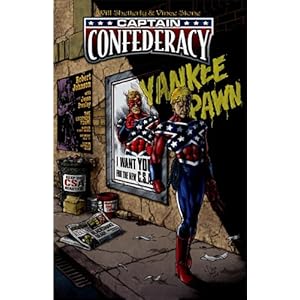
I found another that takes a different approach to the topic: Captain Confederacy. Written by Will Shetterly and drawn by Vince Stone, the alternate-reality comic first appeared in 1986. The plot of the first installment, "The Nature of the Hero," follows a fake super hero, Captain Confederacy, and his white female sidekick Miss Dixie, aka the Dixie Duo. The Captain aims to uphold "justice and the Confederate Way" - meaning paternalism towards African Americans, and the independent slaveholding republic (North America is divided into several countries, including the US, the CS, Mormon-led Deseret, the People's Republic of California, Pacifica, Indian-led Great Spirit Land, Republic of Texas, and the Free State of Louisiana). The Captain, however, suffers a crisis of conscience when he discovers that he is a tool for government propaganda. Merely an actor who received the Ultimate Potential serum, his sole job is to maintain the status quo. His nemesis, Blacksnake (!!!) is also an actor named Aaron Jackson. He is exposed as fraud and eventually becomes a rebel to the Confederacy. In the end, the Captain is forgotten and replaced by a new duo, Kid Dixie and a new Captain.
Shetterly produced two other volumes, "Yankee UFO" and "Hero Worship" but neither are as erudite as "The Nature of the Hero" in discussing the war.
Captain Confederacy strikes me as a commentary on the Civil War, racism, gender and the superhero genre. As an alternate-reality idea, it shows what the Confederacy was: a lie. It was based on a stern, conservative, patriarchal system that resisted change. Whites and blacks, men and women - as well as a half-Chinese, half-white character named Lee to mess with the narrative - had their places, and one could not stray from those roles. He and Miss Dixie represent the ideal Confederate (white) man and (white) woman - one strong and virile, the other feminine yet submissive. Blacks are expected to accept white rule for their own good. Two black characters, Aaron Jackson (whose father is the 'richest Tom' in the CSA) and Kate Williams, struggle against the system. Captain Confederacy is forced to reject the system he symbolized. Readers should call him the anti-Superman - he derives his power from a drug, his reputation exposed as a government plot, and his worst enemy is himself. In this sense, Captain Confederacy presages the "CSA" documentary by several years. The two argue that slavery and slaveholding lay at the heart of the Confederate experiment.
Wednesday, February 29, 2012
Lincoln the International Hero
As I said last week ("Lincoln Statue in Canada", February 22nd, 2012), Abraham Lincoln deserves a statue in Canada because of his international reputation. Indeed there are monuments to him in London and two other British cities, and (of all places) Mexico City. These indicate the extent of Lincoln's fame and legacy. I'd like to cite two literary sources that also indicate his status as a great, noble, even sainted figure.
One of the more In the February 7, 1909 edition of the New York World newspaper, famed Russian writer Leo Tolstoy revealed a story about his encounter with the Lincoln legend. During a visit the year before to the Caucasus Mountains region of southern Russia, he met local Muslim tribesmen (by his description). He wrote that they knew little of the outside world, but they knew of Lincoln. The stories they had heard were mostly myths, but all positive ones. To quote Tolstoy:
"But you have not told us a syllable about the greatest general and greatest ruler of the world. We want to know something about him. He was a hero. He spoke with a voice of thunder; he laughed like the sunrise and his deeds were strong as the rock and as sweet as the fragrance of roses. The angels appeared to his mother and predicted that the son whom she would conceive would become the greatest the stars had ever seen. He was so great that he even forgave the crimes of his greatest enemies and shook brotherly hands with those who had plotted against his life. His name was Lincoln and the country in which he lived is called America, which is so far away that if a youth should journey to reach it he would be an old man when he arrived. Tell us of that man."
He concluded by saying:
"Lincoln is a strong type of those who make for truth and justice, for brotherhood and freedom. Love is the foundation of his life. That is what makes him immortal and that is the quality of a giant. I hope that his centenary birth day will create an impulse toward righteousness among the nations. Lincoln lived and died a hero, and as a great character he will live as long as the world lives. May his life long bless humanity!”
I must wonder about every part of Tolstoy's story. First, it is timed for the centennial of Lincoln's birth. The figures within - the wily Caucasian (no pun intended) and the knowledgeable Russian socialist hero - indicate a huge power vacuum between subject and recorder. He may also have embellished the story for American readers. So we must put this into the "Hmm...maybe" category.
A more credible source is from "When Lincoln Died" by Canadian poet Edward William Thomson (1849-1924) from the same year (1909) as Tolstoy. Thomson was a Civil War veteran, a trooper with the 3rd Pennsylvania Cavalry. He also, interestingly, served in the Canadian Militia during the Fenian Raids of 1866 (normally, the Fenians - those fighting for Irish independence from Britain - are seen as Irish-American veterans of the Civil War; now here's someone on the other side!). In 1909, he published this poem as a tribute to his former commander in chief.
Nonetheless, I think that both are fascinating examples of 19th Century foreigners mind thinking about Lincoln. Tolstoy's and Thomson's views are colored by distance, time, and politics. Yet in each, he is the ideal hero.
One of the more In the February 7, 1909 edition of the New York World newspaper, famed Russian writer Leo Tolstoy revealed a story about his encounter with the Lincoln legend. During a visit the year before to the Caucasus Mountains region of southern Russia, he met local Muslim tribesmen (by his description). He wrote that they knew little of the outside world, but they knew of Lincoln. The stories they had heard were mostly myths, but all positive ones. To quote Tolstoy:
"But you have not told us a syllable about the greatest general and greatest ruler of the world. We want to know something about him. He was a hero. He spoke with a voice of thunder; he laughed like the sunrise and his deeds were strong as the rock and as sweet as the fragrance of roses. The angels appeared to his mother and predicted that the son whom she would conceive would become the greatest the stars had ever seen. He was so great that he even forgave the crimes of his greatest enemies and shook brotherly hands with those who had plotted against his life. His name was Lincoln and the country in which he lived is called America, which is so far away that if a youth should journey to reach it he would be an old man when he arrived. Tell us of that man."
He concluded by saying:
"Lincoln is a strong type of those who make for truth and justice, for brotherhood and freedom. Love is the foundation of his life. That is what makes him immortal and that is the quality of a giant. I hope that his centenary birth day will create an impulse toward righteousness among the nations. Lincoln lived and died a hero, and as a great character he will live as long as the world lives. May his life long bless humanity!”
I must wonder about every part of Tolstoy's story. First, it is timed for the centennial of Lincoln's birth. The figures within - the wily Caucasian (no pun intended) and the knowledgeable Russian socialist hero - indicate a huge power vacuum between subject and recorder. He may also have embellished the story for American readers. So we must put this into the "Hmm...maybe" category.
A more credible source is from "When Lincoln Died" by Canadian poet Edward William Thomson (1849-1924) from the same year (1909) as Tolstoy. Thomson was a Civil War veteran, a trooper with the 3rd Pennsylvania Cavalry. He also, interestingly, served in the Canadian Militia during the Fenian Raids of 1866 (normally, the Fenians - those fighting for Irish independence from Britain - are seen as Irish-American veterans of the Civil War; now here's someone on the other side!). In 1909, he published this poem as a tribute to his former commander in chief.
WE TALKED OF LINCOLN

WE talked of Abraham Lincoln in the night,
Ten fur-coat men on North Saskatchewan's plain
Pure zero cold, and all the prairie white
Englishman, Scotchman, Scandinavian, Dane,
Two Irish, four Canadians all for gain
Of food and raiment, children, parents, wives,
Living the hardest life that Man survives,
And secret proud because it was so hard
Exploring, camping, axeing, faring lean.
Month in and out no creature had we seen
Except our burdened dogs, gaunt foxes gray,
Hard-feathered grouse that shot would seldom slay,
Slinking coyotes, plumy-trailing owls,
Stark Indians warm in rabbit-blanket cowls,
And, still as shadows in their deep-tracked yard,
The dun vague moose we startled from our way.

We talked of Abraham Lincoln in the night
Around our fire of tamarac crackling fierce,
Yet dim, like moon and stars, in that vast light
Boreal, tannery, shifting quick to pierce
Ethereal blanks of Space with falchion streams
Transfigured wondrous into quivering beams
From Forms enormous-marching through the sky
To dissolution and new majesty.
And speech was low around our bivouac fire,
Since in our inmost heart of hearts there grew
The sense of mortal feebleness, to see
Those silent miracles of Might on high
Seemingly done for only such as we
In sign how nearer Death and Doom we drew,
While in the ancient tribal-soul we knew

Our old, hardfaring father-Vikings' dreams
Of Odin at Valhalla's open door,
Where they might see the Battle-father's face
Glowing at last, when Life and Toil were o'er,
Were they but staunch-enduring in their place.

We talked of Abraham Lincoln in the night.
Oh sweet and strange to hear the hard-hand men
Old-Abeing him, like half the world of yore
In years when Grant's and Lee's young soldiers bore
Rifle and steel, and proved that heroes live
Where folk their lives to Labor mostly give.
And strange and sweet to hear their voices call
Him " Father Abraham," though no man of all
Was born within the Nation of his birth.
It was as if they felt that all on Earth
Possess of right Earth's greatest Common Man,
Her sanest, wisest, simplest, steadiest son,
To whom The Father's children all were one,
And Pomps and Vanities as motes that danced
In the clear sunshine where his humor glanced.

We talked of Abraham Lincoln in the night
Until one spoke, " We yet may see his face"
Whereon the fire crackled loud through space
Of human silence, while eyes reverent
Toward the auroral miracle were bent
Till from that trancing Glory spirits came
Within our semi-circle round the flame,
And drew us closer-ringed, until we could
Feel the kind touch of vital brotherhood
Which Father Abraham Lincoln thought so good.
Thomson also penned "Father Abraham Lincoln," a semi-autobiographical work about his time in the War. They appear in his 1909 book "When Lincoln Died and Other Poems." Many of his poems portray the Victorian era's Anglo-Saxon prejudices quite well - about the white man's rule being so benign. We now know that is far from true.
Nonetheless, I think that both are fascinating examples of 19th Century foreigners mind thinking about Lincoln. Tolstoy's and Thomson's views are colored by distance, time, and politics. Yet in each, he is the ideal hero.
Sunday, February 26, 2012
Abraham Lincoln vs. Zombies
This year, it seems, will have three Abraham Lincoln movies. In June, Timur Bekmambetov's Abraham Lincoln: Vampire Hunter, reaches theaters. Based on Seth Graham-Smith's novel, it portrays the Great Emancipator as a man with a secret life of killing vampires. The very premise will make me see it. Alan Tudyk of "Firefly" fame appears as Stephen Douglas, a historical figure who rarely appears in film.
In December, Steven Spielberg's Lincoln debuts, based on (inspired by is perhaps more accurate) Doris Kearns-Goodwin's book Team of Rivals. Its distinguished cast includes Daniel Day-Lewis as the President, Sally Field as Mary, David Strathairn as Seward, and Jared Harris as Grant, among many others. How can any Civil War historian not like what this movie offers? Ace director, great script (caveat above), and authentic Richmond locations - it's a treasure.
Yet the first to come out is the lesser known Abraham Lincoln vs. Zombies. Independent director Richard Schenkman's film comes to theaters on May 22nd and to DVD on May 29th. Made for $150,000 and shot in Savannah, Georgia, it promises to go unnoticed compared to the other two films. Clearly, it is derived from the Graham-Smith book. Still, I'll buy it.
I wonder how many in the Civil War blogosphere know about this.
I hope that the DVD people use the interest from these films to finally release Robert Sherwood's Abe Lincoln in Illinois and other Civil War films to the market.
In December, Steven Spielberg's Lincoln debuts, based on (inspired by is perhaps more accurate) Doris Kearns-Goodwin's book Team of Rivals. Its distinguished cast includes Daniel Day-Lewis as the President, Sally Field as Mary, David Strathairn as Seward, and Jared Harris as Grant, among many others. How can any Civil War historian not like what this movie offers? Ace director, great script (caveat above), and authentic Richmond locations - it's a treasure.
Yet the first to come out is the lesser known Abraham Lincoln vs. Zombies. Independent director Richard Schenkman's film comes to theaters on May 22nd and to DVD on May 29th. Made for $150,000 and shot in Savannah, Georgia, it promises to go unnoticed compared to the other two films. Clearly, it is derived from the Graham-Smith book. Still, I'll buy it.
I wonder how many in the Civil War blogosphere know about this.
I hope that the DVD people use the interest from these films to finally release Robert Sherwood's Abe Lincoln in Illinois and other Civil War films to the market.
Thursday, February 23, 2012
Scandinavians in the Civil War
I have become interested in Scandinavia over the past few years, thanks to my sister's marriage to a Swedish man. The links between the region and the Civil War are considerable. Near my hotel at Djugarden in Stockholm, I discovered a monument to naval engineer and inventor John Ericsson. His creation, the USS Monitor, helped the Union Navy win the Battle of Hampton Roads in March 1862 against the CSS Virginia. Here's a picture of it.

Many thousands of Scandinavians fought in the the war, mostly for the Union. One of the more notable ones was Colonel Hans Heg. Originally from Norway, he emigrated to the US. He commanded the 15th Wisconsin Infantry, a unit comprised of Scandinavian men. This must have been an interesting arrangement given tensions between Norway and Sweden at the time. The two countries had been united, unhappily, into a single kingdom in 1814, lasting until 1905. Danes and Finns had issues with the two as well. I'm also sure other regiments with Scandinavians had similar situations. Heg led the 15th wish distinction in the western theater, Shortly after being promoted to brigade command, he was killed in action at Chickamauga in September 1863. Here's a picture of his memorial on the battlefield.

Subscribe to:
Posts (Atom)